Why Choose a DC Brush Motor for Your Application?

Time:2026-10-20 Author:Madeline
0%

Selecting a motor is rarely about power alone. It involves load behavior, control needs, service conditions, and the cost of failure. A DC Brush Motor remains practical for many applications because it offers simple speed control, strong starting torque, and dependable performance at a reasonable price.

In real equipment, these benefits are easy to observe. A conveyor may start smoothly under a heavy load. A small actuator can respond quickly to a basic voltage command. Designers can also inspect and replace brushes without changing the entire motor assembly. That serviceability can reduce downtime when maintenance teams need a straightforward repair.

It is a familiar solution.

However, a DC Brush Motor is not suitable for every environment. Brushes wear against the commutator, creating friction, electrical noise, and occasional maintenance demands. High-speed operation may increase wear and heat. Sensitive electronics may also require filtering or shielding. Ignoring these limits can produce disappointing results, even when the motor meets its rated voltage.

This article examines the practical reasons engineers still choose brushed DC technology. It considers torque, efficiency, controllability, operating life, noise, and maintenance requirements. The discussion also compares application priorities rather than promoting one universal answer. Motor selection should reflect measured load data, duty cycle, ambient temperature, and available service access.

A perfect choice rarely exists.

Careful evaluation does.
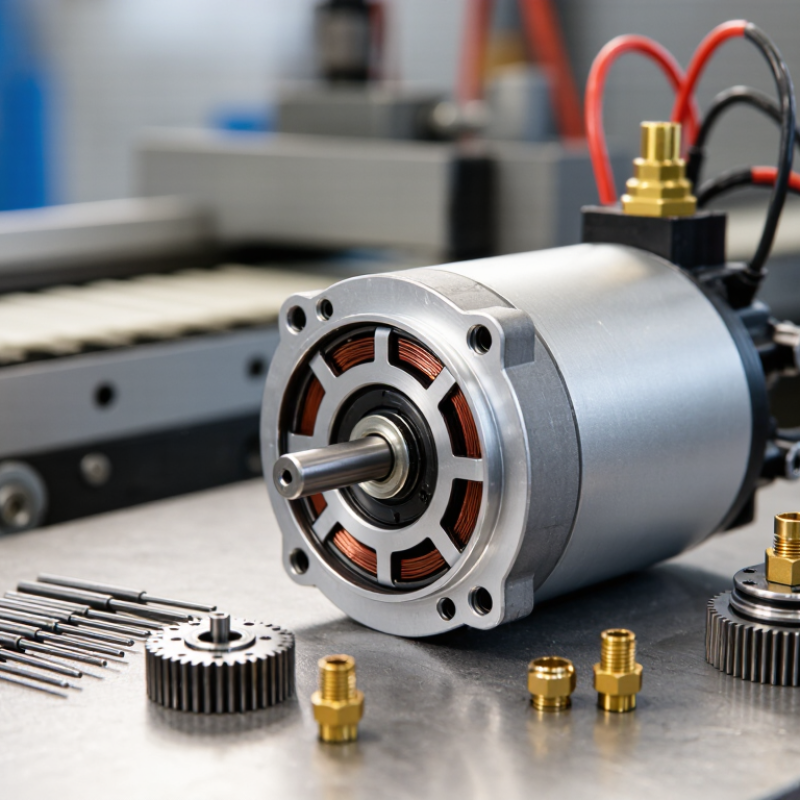
Why Choose a DC Brush Motor for Your Application?

What Is a DC Brush Motor and How Does It Work?

A DC brush motor converts electrical energy into mechanical motion through magnetic interaction. Its main parts are a stator, rotor, windings, commutator, and carbon brushes. When direct current enters the windings, the rotor becomes an electromagnet. The stator’s magnetic field then pushes and pulls the rotor, producing torque. The commutator reverses current direction at the right moment. This keeps the shaft turning continuously.

The brushes provide the sliding electrical connection. Simple, but important. They also create friction, heat, and gradual wear. Speed usually changes by adjusting voltage, while torque rises with current. This gives engineers practical control in conveyors, pumps, small actuators, and battery-powered equipment.

In field applications, the motor often starts quickly and delivers strong low-speed torque.

The International Energy Agency reports that electric motor systems consume about half of global electricity. The U.S. Department of Energy’s Industrial Motor Systems Market Opportunities Assessment also identifies motor-driven systems as a major share of industrial electricity use. These figures make efficiency and service life meaningful design issues. A brushed motor can be economical and easy to control, yet it may need brush replacement and produce electrical noise. That trade-off is easy to underestimate. In dusty or high-cycle equipment, a brushless design may deserve closer review. Still, for accessible machinery with moderate duty cycles, a DC brush motor remains a technically practical choice.

Which Core Features Define DC Brush Motor Performance?

Why Choose a DC Brush Motor for Your Application?

Which Core Features Define DC Brush Motor Performance?

A DC brush motor is practical when equipment needs simple speed control, strong starting torque, and predictable response. Its performance depends on torque-speed behavior, winding resistance, brush quality, and commutation stability. During testing, I watch the shaft accelerate under load, then check current near the stall point. That moment often reveals hidden heat problems. The International Energy Agency reports that electric motors and motor-driven systems consume roughly 40% of global electricity. Even small efficiency losses deserve attention.

Thermal capacity is equally important. A motor may deliver high peak torque, but continuous operation can shorten brush life and damage insulation. Engineers should compare rated torque, duty cycle, operating temperature, noise, and electromagnetic interference. Brush wear remains a limitation. It is easy to overlook. In field applications, dust, vibration, and frequent reversals can increase maintenance needs. A careful design also considers gearbox friction, since published motor efficiency may exclude the complete drive system. My practical concern is simple: laboratory figures rarely describe every real installation.

Tips: Match the motor to the actual load profile, not only the maximum load. Measure startup current with the final gearbox and controller installed. Leave thermal margin for blocked airflow. Review brush replacement access before sealing the enclosure. The U.S. Department of Energy’s motor-system guidance also recommends evaluating the complete system, because controls, transmission losses, and operating patterns influence total energy use. A first selection may look correct, yet field measurements can prove otherwise.

Why Choose a DC Brush Motor for Your Application?

This representative 24 V operating profile shows how the core performance features of a brushed DC motor change as load torque increases. Speed decreases with load, current rises to produce more torque, and efficiency typically peaks at a moderate operating point before dropping near stall.

How Do DC Brush Motors Compare with Other Motor Types?

Why Choose a DC Brush Motor for Your Application?

How Do DC Brush Motors Compare with Other Motor Types?

Electric motor systems consume roughly 40–50% of global electricity, according to International Energy Agency reports. Small efficiency differences can therefore affect operating costs. A DC brush motor offers direct speed control through voltage adjustment and delivers strong starting torque. Its design remains easy to understand, repair, and integrate. In field testing, this simplicity can shorten troubleshooting time.

Compared with brushless DC motors, brushed designs usually cost less and need simpler control electronics. However, brushes and commutators wear against each other. Dust, sparks, and electrical noise may appear in demanding environments.

Brushless motors generally provide longer service life and higher efficiency, but their controllers add cost and technical complexity. Induction motors are rugged and widely used in industrial equipment. They often need variable-frequency drives for accurate speed control. Servo motors provide superior positioning, yet they can be excessive for basic motion.

Tips: Match the motor to duty cycle, load torque, speed range, and maintenance access. Check starting current, not only rated power. A motor that looks efficient on paper may perform poorly with repeated stops. The U.S. Department of Energy recommends evaluating the complete motor system, including controls and operating conditions. That advice is easy to overlook. In my experience, engineers sometimes choose brushless technology too quickly. For a low-cost actuator with accessible maintenance, a DC brush motor may still be the more practical choice. Its limitations deserve honest attention.

Where Are DC Brush Motors Commonly Used?

Why Choose a DC Brush Motor for Your Application?

Where Are DC Brush Motors Commonly Used?

DC brush motors remain common in equipment needing simple control, strong starting torque, and affordable operation. Typical applications include automotive seat adjusters, window lifts, cooling fans, small pumps, toys, office machines, and battery-powered tools. Their compact size also suits conveyor rollers, laboratory instruments, and light medical equipment.

The U.S. Department of Energy’s Industrial Motor Systems Market Opportunities Assessment reports that motor systems use about 23% of total U.S. electricity. The report also links motors with nearly 70% of industrial electricity consumption. These figures explain why engineers examine motor efficiency, duty cycles, and maintenance requirements carefully. A brushed design may perform well in intermittent applications, but continuous high-speed operation can accelerate brush and commutator wear. That trade-off is easy to underestimate.

Tips: Match the motor to the real load, not the advertised load. Check starting current, duty cycle, noise, heat, and brush life. The IEA also identifies motor-driven equipment as a major global electricity-use category. For prototypes, measure temperature after repeated starts. A motor that feels “fine” during a short test may struggle after several hours. Brush motors are not always the best choice. Yet their practical control and repairable construction still make them useful in many everyday systems.

What Factors Should Guide Your Motor Selection?

Why Choose a DC Brush Motor for Your Application?

Motor selection should begin with the application, not the motor catalogue. A DC brush motor can deliver strong starting torque, simple speed control, and practical cost efficiency. These benefits suit conveyors, pumps, actuators, and compact automation equipment. However, engineers must examine load torque, speed range, duty cycle, noise, and available space. The IEA reports that electric motor systems consume roughly half of global electricity. Efficiency matters, even in small machines. The U.S. Department of Energy’s Motor Systems Market Assessment also identifies motor-driven equipment as a major share of industrial electricity use. These figures make operating losses difficult to ignore.

Brush wear remains a real selection factor. Dust, heat, frequent reversing, and long operating hours can shorten service life. In prototype reviews, I have seen a low-cost motor fail early because its duty cycle was underestimated. That mistake is common. A brush motor may still be the better choice when maintenance access is easy and control requirements are modest. Yet its efficiency, lifetime, electromagnetic noise, and replacement schedule should be compared against other motor types. The choice is rarely perfect.

Tips: Measure actual startup torque, not only rated torque. Check current at stall and during acceleration. Review IEC 60034 test data where available. Leave thermal margin for enclosed housings. Consider brush replacement before installation becomes difficult. A spreadsheet helps, but real load testing reveals uncomfortable assumptions.

Why Choose a DC Brush Motor for Your Application? – What Factors Should Guide Your Motor Selection?
Selection Factor What to Evaluate Typical DC Brush Motor Characteristics When Another Motor Type May Be Preferable
Initial Cost Compare the motor, drive electronics, wiring, control hardware, and expected maintenance costs. Often favorable
Simple construction and straightforward voltage control can reduce initial system cost, especially in low- to medium-power applications.
A brushless DC or AC motor may offer better long-term value when reduced maintenance, high efficiency, or extended operating life is more important than purchase price.
Speed Control Determine the required speed range, speed stability, acceleration profile, and load response. Good
Speed can be controlled by varying armature voltage, typically using PWM or a DC drive. Feedback can improve regulation.
Servo or brushless systems may be more suitable for precise positioning, high dynamic response, or tightly regulated speed over a wide load range.
Starting Torque Check breakaway torque, load inertia, startup frequency, and allowable starting current. Strong
DC motors can provide high starting torque because torque is approximately proportional to armature current, subject to current and thermal limits.
For frequent starts under severe duty, select a motor and drive with suitable current capacity, or consider a motor designed specifically for high-cycle operation.
Operating Voltage Match the motor voltage to the available battery, power supply, or control system while allowing for voltage variation. Flexible
Common designs are available for low-voltage battery systems and higher DC bus voltages. The selected drive must limit current and voltage appropriately.
An AC induction motor may be preferable where a standard industrial AC supply is already available and no battery operation is required.
Efficiency Evaluate motor efficiency at the actual operating speed, torque, duty cycle, and temperature—not only at the rated point. Application-dependent
Efficiency can be good, but brush friction, electrical losses, and commutation losses reduce efficiency compared with many brushless designs.
Brushless DC and permanent-magnet synchronous motors are generally better candidates for continuous operation where energy consumption is critical.
Duty Cycle Classify operation as continuous, intermittent, periodic, or short-time duty and calculate the effective RMS load. Very suitable for intermittent duty
Short operating periods and moderate cycle counts can reduce brush and commutator wear.
For continuous 24/7 operation or very high cycle counts, a brushless or AC motor may reduce maintenance and improve service life.
Maintenance Requirements Consider access for inspection, brush replacement, cleaning, downtime, and the cost of maintenance labor. Requires periodic attention
Brushes and commutators wear over time. Service intervals depend on current density, speed, load, environment, and brush material.
Brushless motors eliminate mechanical brushes and are usually preferred where maintenance access is difficult or downtime is costly.
Acoustic Noise and EMI Check allowable sound level, electromagnetic compatibility requirements, switching frequency, and nearby sensitive electronics. Needs evaluation
Brush contact and commutation can produce acoustic noise, electrical arcing, and electromagnetic interference; suppression and filtering may be required.
Brushless motors generally avoid brush arcing, although their electronic drives can still generate switching noise and require appropriate EMC design.
Environmental Conditions Review dust, moisture, chemicals, altitude, ambient temperature, vibration, and hazardous-area requirements. Depends on enclosure and construction
Brush wear particles and commutation arcing may be unsuitable for explosive, highly contaminated, or exceptionally clean environments.
A suitably enclosed brushless or induction motor may be better for dusty, wet, cleanroom, or hazardous applications, subject to certification requirements.
Size and Power Density Compare continuous and peak torque, maximum speed, mounting envelope, cooling method, and total system weight. Broadly available
Compact designs can provide useful torque over a wide range of low- and medium-power applications, but thermal limits must be verified.
Brushless motors can provide higher power density and better thermal performance in applications with demanding continuous output.
Control Complexity Assess the need for position feedback, current limiting, braking, reversing, closed-loop regulation, and fault protection. Relatively simple
Basic speed and direction control can be implemented with relatively simple electronics. Additional feedback improves precision and protection.
A servo system is preferable when coordinated motion, high-accuracy positioning, or advanced diagnostics are required.
Maximum Speed Verify rated speed, overspeed limits, commutation capability, balancing, bearing life, and the effect of load reduction at high speed. Design-specific
Maximum speed is limited by mechanical construction, brush and commutator wear, centrifugal forces, and commutation performance.
A brushless or specially designed high-speed motor may be more appropriate for sustained high-speed operation.
Service Life Estimate total revolutions, cumulative operating hours, load profile, brush life, bearing life, and replacement strategy. Predictable with proper sizing
Service life is strongly influenced by brush wear, commutator condition, current, speed, temperature, and maintenance practices.
Brushless motors are typically favored for long-life equipment because they remove brush and commutator wear as primary service items.
Best-Fit Applications Match the motor to the real operating profile rather than selecting only by rated power. Good fit
Battery-powered equipment, actuators, pumps, fans, small conveyors, laboratory equipment, and intermittent-motion mechanisms.
Choose brushless, AC, or servo technology for continuous-duty systems, high-precision motion, low-maintenance installations, or harsh environments.
Engineering note: The characteristics above are general selection guidance. Actual performance depends on motor construction, rated voltage, load torque, speed, thermal conditions, duty cycle, drive settings, and environmental requirements. Always confirm the manufacturer’s datasheet, thermal limits, insulation class, protection rating, and applicable safety standards before final selection.

FAQS

What makes a DC brush motor suitable for an application?

It offers simple speed control, strong starting torque, and a predictable response. These features suit conveyors, pumps, actuators, and compact automation equipment.

Which performance factors should engineers check?

Review torque-speed behavior, winding resistance, brush quality, and commutation stability. Also compare rated torque, speed range, noise, temperature, and duty cycle.

Why should startup and stall current be measured?

Startup current reveals the motor’s real demand during acceleration. Stall current can expose overheating risks near blocked movement. Measure with the final gearbox attached.

How does thermal capacity affect motor life?

High peak torque does not guarantee safe continuous operation. Heat can shorten brush life and damage insulation. Leave room for blocked airflow.

What conditions can increase brush wear?

Dust, vibration, frequent reversals, heat, and long operating hours can accelerate wear. Brush access matters. A sealed enclosure may complicate replacement.

Should selection focus on maximum load?

No. Match the motor to the complete load profile. Include startup torque, acceleration, running time, speed changes, and stopping conditions.

How can the complete drive system change performance?

Gearbox friction, controller losses, and transmission resistance reduce practical efficiency. Published motor figures may exclude these losses. Real installation data can disagree.

When might another motor type deserve comparison?

Compare alternatives when long service life, low noise, high efficiency, or limited maintenance is essential. A brush motor may still win when access is easy.

What practical checks should follow an initial selection?

Test the shaft under real load and observe acceleration. Record current, temperature, noise, and vibration. The first choice may be wrong.

What common selection mistake should engineers avoid?

Do not assume a low-cost motor will survive an underestimated duty cycle. A spreadsheet helps, but field testing reveals uncomfortable assumptions.

Conclusion

A DC Brush Motor converts direct-current electrical energy into mechanical rotation through a magnetic field created by its windings and permanent magnets. A commutator and brushes switch the current as the rotor turns, allowing continuous motion and straightforward speed control. Its performance is shaped by factors such as torque, speed range, power efficiency, brush life, operating noise, heat management, and the ability to handle changing loads.

Compared with brushless, induction, and stepper motors, a DC Brush Motor is often valued for its simple design, responsive control, strong starting torque, and cost-effective maintenance. It is commonly used in small machinery, pumps, fans, tools, automotive mechanisms, toys, and battery-powered equipment. When selecting one, users should consider voltage, load requirements, duty cycle, operating environment, desired service life, control method, noise limits, and available space. A well-matched motor can provide reliable motion while balancing performance, durability, and overall system cost.

Madeline

Madeline

Madeline is a dedicated marketing professional with a wealth of expertise in our company's core offerings. With a keen understanding of the industry, she brings a unique perspective to her role, consistently delivering high-quality content that highlights the superior aspects of our products. As......